| Tools: Save | Print | " target="_blank" class="style1">E-mail | Most Read |
| Helping Kids Foster Respect for Rare Species |
| Adjust font size: |
|
Near the gateway to the Milu Park Museum in southern Beijing's Daxing District there is a black box containing the most dangerous animal in the world.
Opening a door reveals a sign that reads: "You will soon face the most dangerous animal. It feeds itself with the meat of other animals but is never satisfied." The next door uncovers a mirror reflecting the image of the visitor.
The black box is one of many interesting devices the deer park uses to teach animal lovers something different.
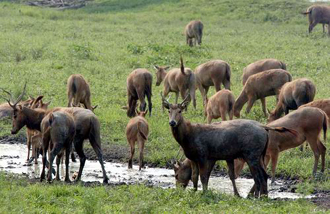
Observing the deer that give Milu Park its name is rather difficult as they do not like to stand near the fences.
According to Guo Geng, the deputy director of the park, the extremely shy nature of milu has helped the animals become the only species to successfully return to the wild after being reintroduced to China. Other species that have been reintroduced include Przewalski's horses and Saiga antelope.
Because they do not fear humans, poachers find it easier to hunt them in their natural habitats, Guo said.
"I was often asked by the visiting children: 'Uncle Guo, I love milu so deeply, so why can't I touch or feed it?' Then I answered: 'Will you allow some other animals to feed you if they like you so much?'" said Guo.
But there are lots of other fun activities for children. They can climb into a bird's nest made of cement, if they can find the hidden sanctuary.
Once there, they can experience the anxiety of little birds waiting for their parents to bring home food, while keeping out of sight of predators.
Guo has even suggested young visitors enter a dozen steel cages of different sizes. The children stay for as long as they can bear, so as to feel what it is like to be a caged wild animal.
"When you go home, you can tell your friends and relatives to free caged birds," said Guo.
He has also planted a labyrinth of trees. At the end of each impasse there is an admonition that tells visitors about animal maltreatment. On each pathway, signposts demonstrate elements of animal conservation.
(China Daily February 14, 2006) |
| Tools: Save | Print | " target="_blank" class="style1">E-mail | Most Read |
 |
| Related Stories |
|
