 Share:

As the war in Ukraine drags on and wrangling continues over a U.S.-backed "peace plan," the North Atlantic Treaty Organization (NATO) foreign ministers met in Brussels on Wednesday for their last gathering of the year.
However, instead of signaling unity, the meeting drew scrutiny over the rare absence of the U.S. Secretary of State for the first time in over two decades, as well as disagreements among allies over how to arm Ukraine, and mounting tensions over who should reap the industrial benefits of rearmament.

Flags of European Union (EU) and Ukraine are seen at the EU headquarters in Brussels, Belgium, Feb. 24, 2025. [Photo/Xinhua]
U.S. absence stirs doubts
NATO usually holds two formal foreign ministers' meetings a year. U.S. Secretary of State Marco Rubio did not attend Wednesday's meeting, sending Deputy Secretary of State Christopher Landau in his place.
In an interview with Al Arabiya, former NATO arms control director William Alberque described Rubio's absence as "unusual." NATO would normally reschedule the meeting to accommodate a U.S. absence, he said.
A senior U.S. State Department official argued that Rubio has already held dozens of meetings with his counterparts, and that it is "unrealistic" to expect him to attend every single one.
Rubio's decision to send Landau in his place is also telling, since many in European diplomatic circles see the latter as skeptical of NATO. In the past, Landau has questioned the alliance's relevance on social media, calling it "a solution in search of a problem."
Rubio's absence from the latest NATO foreign ministers' meeting is likely to further fuel European allies' anxiety about being sidelined and deepen their distrust of the United States, analysts said.
Burden-sharing rifts
Since the Trump administration has significantly cut U.S. military assistance to Ukraine starting this summer, NATO has set up a "Prioritized Ukraine Requirements List" (PURL). This allows European allies to contribute funds for NATO to buy weapons for Ukraine from U.S. stockpiles.
NATO Secretary General Mark Rutte said that more than two-thirds of NATO members have already pledged contributions through the PURL, with commitments from European countries and others expected to exceed 5 billion U.S. dollars at the end of this year.
However, the European Union (EU) estimates that Ukraine will need at least 83 billion euros (around 97 billion U.S. dollars) in military support over the next two years, leaving a significant funding gap.
Although Wednesday's meeting saw several countries announcing new commitments, several states have yet to make pledges under the mechanism. France said it prefers to donate European-made equipment, while Italy wanted to focus more on diplomatic efforts toward a cease-fire.
This mix of big spenders and cautious bystanders has fueled dissatisfaction inside NATO. Lithuanian Foreign Minister Kestutis Budrys called for collective financing efforts for the next year on his arrival at NATO headquarters.
Nevertheless, Hungarian Foreign Minister Peter Szijjarto said after the Brussels session that Hungary will not participate in the PURL.

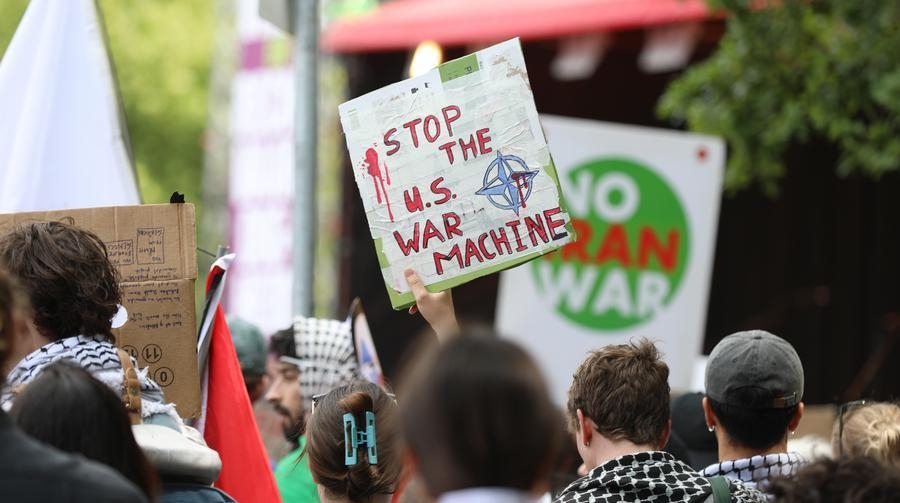
Protesters holding placards are pictured in The Hague, the Netherlands, June 22, 2025. The protest, attended by hundreds, took place two days before the NATO summit, where member states are expected to push for increased defense spending. [Photo/Xinhua]
U.S. pressure vs. "buy European" push
Beyond the question of who pays how much, the NATO meeting also laid bare a focus: who gets the contracts.
Currently, many of the weapons systems, which are most critical to Ukraine's defense, come from the United States.
However, Europe has not given up its bid to replace U.S. output in the long term. The EU has launched a new "Security Action For Europe" instrument that offers up to 150 billion euros in financial support for member states' security and defense procurement. The EU has made clear it wants those funds to strengthen Europe's own defense industrial base, with roughly 65 percent of equipment sourced from European manufacturers, and no more than 35 percent from third countries.
According to Politico Europe, Landau lashed out at his European counterparts during Wednesday's closed-door meeting, blaming them for trying to "bully" U.S. defense firms out of the bloc's rearmament efforts.
However, analysts point out that the United States is, on the one hand, pressuring the EU on trade, while on the other, insisting that Europe refrain from taking protectionist measures against U.S. products and buy American weapons.
Ferenc Kelemen, a U.K.-based business analyst, commented that Europe is now facing a stark choice: either it takes on the new role of a funding mechanism for American-designed security arrangements, or it accepts trans-Atlantic fractures. "There is no third option," he said. (1 euro = 1.17 U.S. dollar)


 京公網安備 11010802027341號