


A drone photo shows a view of the Tuyugou Grottoes in Turpan, northwest China's Xinjiang Uygur Autonomous Region May 1, 2025. Two major archaeological sites along the ancient Silk Road opened to the public in northwest China on Thursday, the first day of the May Day holiday, offering new choices for travelers keen to explore the exchanges between Eastern and Western civilizations over a millennium ago. (Xinhua)
Two major archaeological sites along the ancient Silk Road opened to the public in northwest China on Thursday, the first day of the May Day holiday, offering new choices for travelers keen to explore the exchanges between Eastern and Western civilizations over a millennium ago.
One of these newly opened sites, the Tuyugou Grottoes, is located in the city of Turpan, Xinjiang Uygur Autonomous Region. This complex, built around the fifth century, boasts 157 caves carved into cliffs, three temples and nine pagodas.
Five caves and a Buddhist temple at the grottoes have opened to the public, offering 300 visitor slots per day, said Liu Yi, a cultural relics preservation official of Turpan's cultural heritage bureau.
Ten archaeological excavations since 2010 at the site have unearthed abundant artifacts, including Buddhist scriptures in multiple languages as well as documents like taxation records and loan contracts.

A guide introduces the murals to visitors at the Tuyugou Grottoes in Turpan, northwest China's Xinjiang Uygur Autonomous Region, May 1, 2025. (Xinhua)
China has invested more than 77 million yuan (about 10.7 million U.S. dollars) in restoring and reinforcing these grottoes in recent years.
"The Tuyugou Grottoes are a vivid testimony to the cultural and religious exchanges in the Turpan Basin," said Xia Lidong, associate researcher at the Institute of Archaeology, Chinese Academy of Social Sciences.
The ruins of Xuanquanzhi in the city of Dunhuang, Gansu Province, also opened to the public on Thursday.
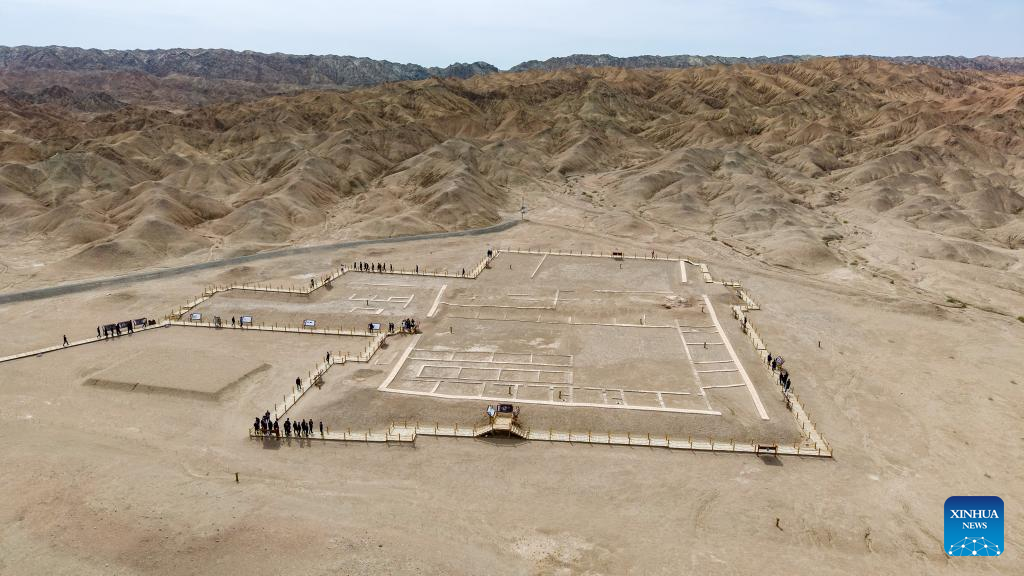
A drone photo shows guests visiting the ruins of Xuanquanzhi in Dunhuang, northwest China's Gansu Province, April 29, 2025. (Xinhua/Lang Bingbing)
Dating back some 2,000 years to the Western Han Dynasty, the site back then served as a comprehensive post station for mail and information deliveries, as well as the reception of messengers, officials and foreign guests. It is one of the Silk Road sites that were added to the UNESCO World Heritage List in 2014.
Following excavations in the early 1990s, the site was accessible only to research teams. Thanks to investments totaling over 309 million yuan, China strengthened preservation of the site and developed tourism facilities.
"Through its remarkable efforts in cultural preservation, China has reminded the world that heritage is not static. It lives, breathes and teaches," said Qaiser Nawab, chairman of the Belt and Road Initiative for Sustainable Development.
Addressing the needs of international tourists, the site's guiding and interpretation services are available in multiple languages.
Samuel Fanning, a tourist and history lover from Canada, was attracted by Turpan's ancient architecture.
"I planned to stay in Xinjiang for seven days, but it will end up being 12 days. I think this can speak to how enjoyable it is to visit here," Fanning said, adding that he will also visit Dunhuang.

Performers dance at the opening ceremony of the ruins of Xuanquanzhi in Dunhuang, northwest China's Gansu Province, April 29, 2025. (Photo by Zhang Xiaoliang/Xinhua)
Qiu Jian, head of the Gansu provincial cultural heritage bureau, revealed that global interest in the ancient Silk Road is steadily rising.
"Through the gradual opening of more cultural heritage sites, we aim to present an overall and more diverse picture of the Silk Road culture to the public," said Qiu.


 京公網安備 11010802027341號
 主站蜘蛛池模板:
和田市|
茶陵县|
商城县|
义马市|
荥阳市|
东山县|
建始县|
庆阳市|
柳林县|
丹东市|
凯里市|
佛冈县|
香港
|
天门市|
苏州市|
长葛市|
东至县|
娱乐|
安龙县|
怀宁县|
图木舒克市|
大化|
河南省|
潞城市|
郎溪县|
昭平县|
图片|
内丘县|
株洲市|
万州区|
织金县|
江油市|
建水县|
万州区|
济源市|
运城市|
大足县|
汤原县|
洛扎县|
武陟县|
高雄县|
主站蜘蛛池模板:
和田市|
茶陵县|
商城县|
义马市|
荥阳市|
东山县|
建始县|
庆阳市|
柳林县|
丹东市|
凯里市|
佛冈县|
香港
|
天门市|
苏州市|
长葛市|
东至县|
娱乐|
安龙县|
怀宁县|
图木舒克市|
大化|
河南省|
潞城市|
郎溪县|
昭平县|
图片|
内丘县|
株洲市|
万州区|
织金县|
江油市|
建水县|
万州区|
济源市|
运城市|
大足县|
汤原县|
洛扎县|
武陟县|
高雄县|