Chinese archaeologists have found a group of vast rings at the
site of the 1,300-year-old tomb of Wu Zetian, China's only empress,
but are unable to explain their existence.
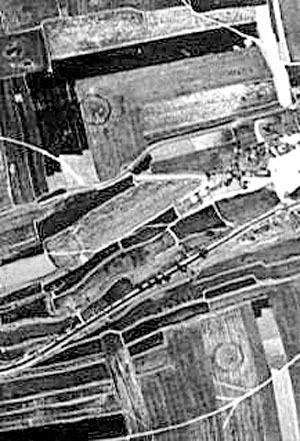
At least 10 rings appeared on aerial photographs taken by experts
from the
Xi'an Preservation and Restoration Center of
Cultural Relics and Qianling Museum in a survey of Qianling.
Most of the rings are between 30 to 40 meters in diameter and
are situated in an area four kilometers long from east to west and
two kilometers from south to north, said Qin Jianming, a researcher
with the center.
The most eye-catching was the largest ring, with a diameter of
110 meters, he said.
Qin said the foundation of the largest ring was three meters
thick with a color markedly darker than the fields. Three quarters
of the ring were clearly visible, despite being broken by a
footpath.
"At first we believed the rings were atmospheric phenomena
caused by lights, but after analysis and comparison with previous
aerial photos, we are sure they are historic remains," he said.
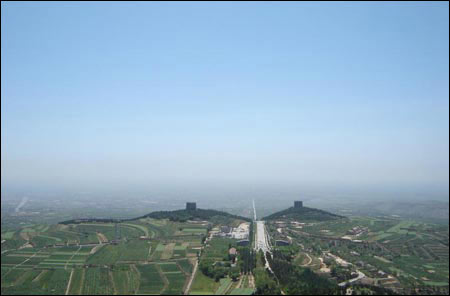
Located 80 kilometers northwest of Xi'an, lies the joint tomb of
Wu Zetian, who ruled for 50 years, and her husband, Emperor Li Zhi
of the Tang Dynasty (618-907).
It is the only tomb in China which contains the bodies of two
rulers. Wu Zetian was buried in the tomb 22 years after her
husband.
Qianling is the best preserved ancient tomb in China and has
survived without being looted.
The researchers conducted a ground search for the rings three to
five kilometers from Lianshan mountain range, which was the
territory of Qianling, but they proved difficult to see from the
ground.
"The layout of the rings seems irregular and some are no longer
intact. We are assuming there were more rings in the past, but they
have eroded due to geographical conditions and human activities,"
said Qin.
Despite searches of historical records, the researchers still
have no idea of the purpose of the rings or their relation with the
tombs.
"Based on our experience, we assume they were tunnels built in
ancient times," said Qin.
However, the center of the largest ring was an excavated tomb
belonging to a ruler of the Yan State in the Tang Dynasty, a
subsidiary tomb of Qianling, but it remains uncertain whether the
ring was part of the tomb, said Fan Yingfeng, head of the Qianling
Museum.
"Human activities in that area began in New Stone Age. Emperor
Qin Shihuang built a palace there and rebellious forces in late
Tang Dynasty occupied the area as well," he said.
Experts said the discovery indicated there might be more
historic relics yet to be discovered in the Qianling area.
Qianling
Mausoleum
(Xinhua News Agency December 21, 2006)